
Where to Build Your Fence: Protect the Corner
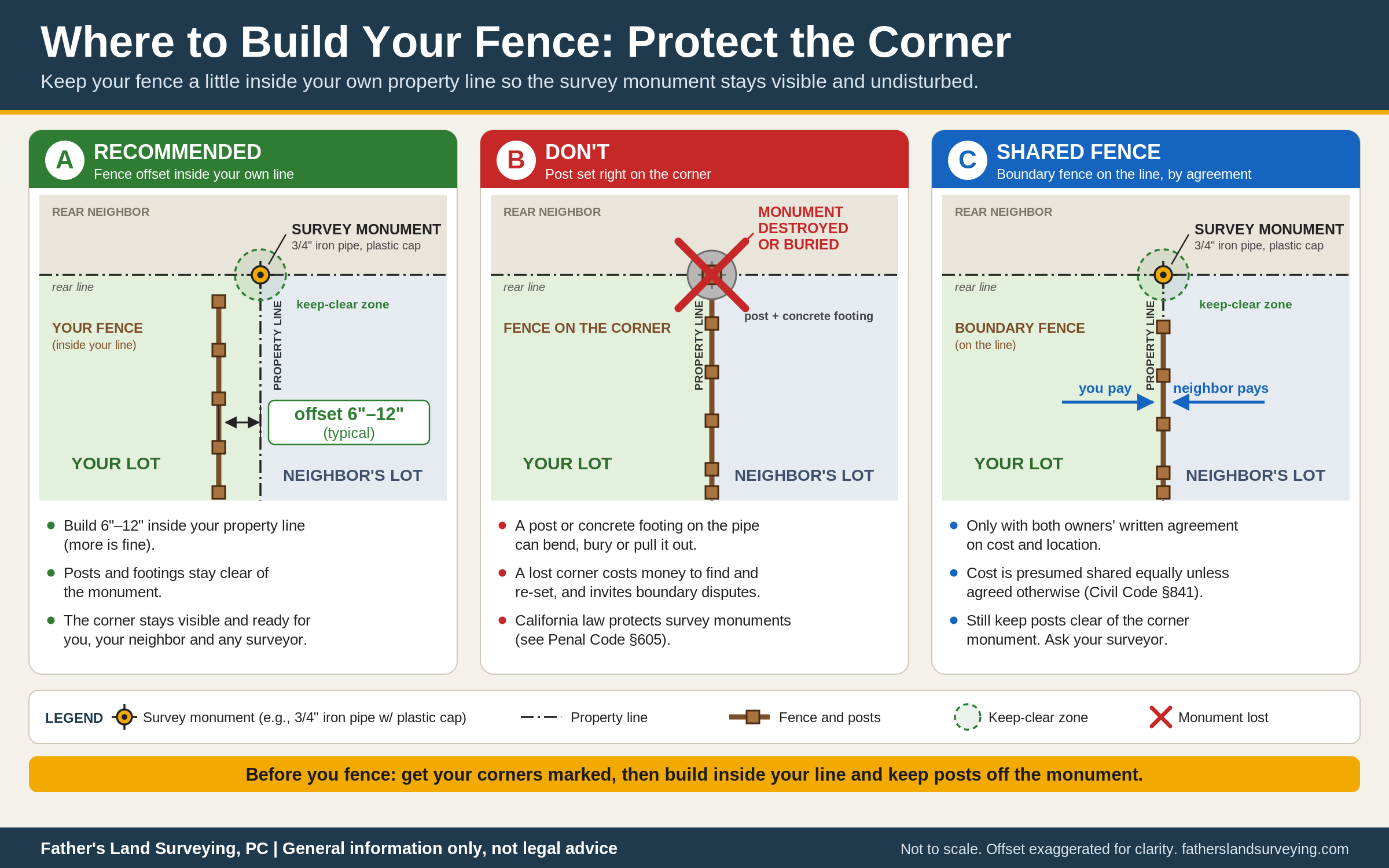
You hired a surveyor, the corners are marked, and now you are ready to build a fence. Congratulations! Before the post-hole digger shows up, let's talk about the one spot where a fence should not go: right on top of your new property corner monument.
What is that thing in the ground?
When we mark a corner, we usually set a 3/4" iron pipe with a plastic cap (sometimes rebar with a cap, or a brass disk) stamped with the surveyor's license number. It may look small, but that monument is the physical evidence of your boundary. It is what the next surveyor, your neighbor, and a title company will look for years from now.
Keep the fence a little inside your line
Our advice is simple: build your fence on your own side of the property line. An offset of about 6 to 12 inches is typical, and a little more is perfectly fine. That small gap does a lot of work:
The monument stays visible and undisturbed.
Posts and concrete footings stay clear of the pipe, so it won't get bent, buried, or pulled out.
You are not guessing about who owns the fence or the strip beneath it.
Why not right on the corner?
A fence post (and the concrete around it) set directly on a monument can bend it, bury it, or pull it right out of the ground. Once a monument is lost, someone has to pay a surveyor to find the corner again and re-set it. That is an avoidable cost. Please also have your fence contractor keep an eye out when digging, and call us if a monument is in the way.
What about a shared fence on the line?
Sometimes neighbors would rather build one fence together, right on the line. That can work well, if both owners agree in writing on the location and on who pays. Even then, the posts should be placed so they don't sit on the monument. Talk to your neighbor first (see our post, Discussing a Boundary Survey with your Neighbor), and have us reference the corner before any digging starts.
Don't forget your city or county rules
Fence height and location rules vary a lot from place to place. As a general idea, side and rear fences are often allowed up to about 6 feet, and front-yard fences are often limited to roughly 3 to 4 feet, but your local rules may be different, and permits or design review may apply. Check with your city or county planning department before you build.
Legal references (general information, not legal advice)
This is a plain-language summary for education only. Laws change and every situation is different, so please talk with a California attorney about your own circumstances.
Civil Code § 841: Adjoining owners share responsibility for maintaining the boundaries and monuments between them, and are presumed to share a dividing fence's reasonable cost unless they agree otherwise in writing. Before incurring fence costs, an owner generally must give affected neighbors 30 days' written notice. Link
Civil Code § 841.4: A fence over 10 feet built or kept maliciously to annoy a neighbor can be a private nuisance. Link
Penal Code § 605: Maliciously removing a boundary monument, or defacing its marks, is a misdemeanor. Link
Business & Professions Code § 8771: Monument-preservation rules for certain construction work. A monument that could be destroyed or covered must be referenced by a licensed surveyor and reset or witnessed, with a corner record or record of survey filed. Link
Civil Code § 1007 and Code of Civil Procedure § 325: Adverse possession generally takes five years of open, hostile occupation plus payment of property taxes. A fence is not automatically the legal boundary. Civ. Code § 1007, CCP § 325
Agreed boundary doctrine: Neighbors can sometimes fix an uncertain line by agreement, but a fence alone, without uncertainty and agreement, generally does not move a boundary. See Bryant v. Blevins (1994) 9 Cal.4th 47. Link
Local rules (example): Permit Sonoma fence guidelines.
Ready to fence? Call us first
If you are thinking about a new fence, a retaining wall, or any project near your lines, let us mark or confirm your corners first. It is faster and cheaper than digging up a problem later. Give us a call or send an email, and we'll be happy to walk through what to expect.
Sincerely,
Aiden J. Sanchez
PLS 9963
aiden@fatherslandsurveying.com | Main: (415) 493-8713 | Sonoma County: (707) 623-2228
Father's Land Surveying, PC. General information only, not legal advice.